

David Kogan speech to Financial Times Business of Football Summit
Date Published
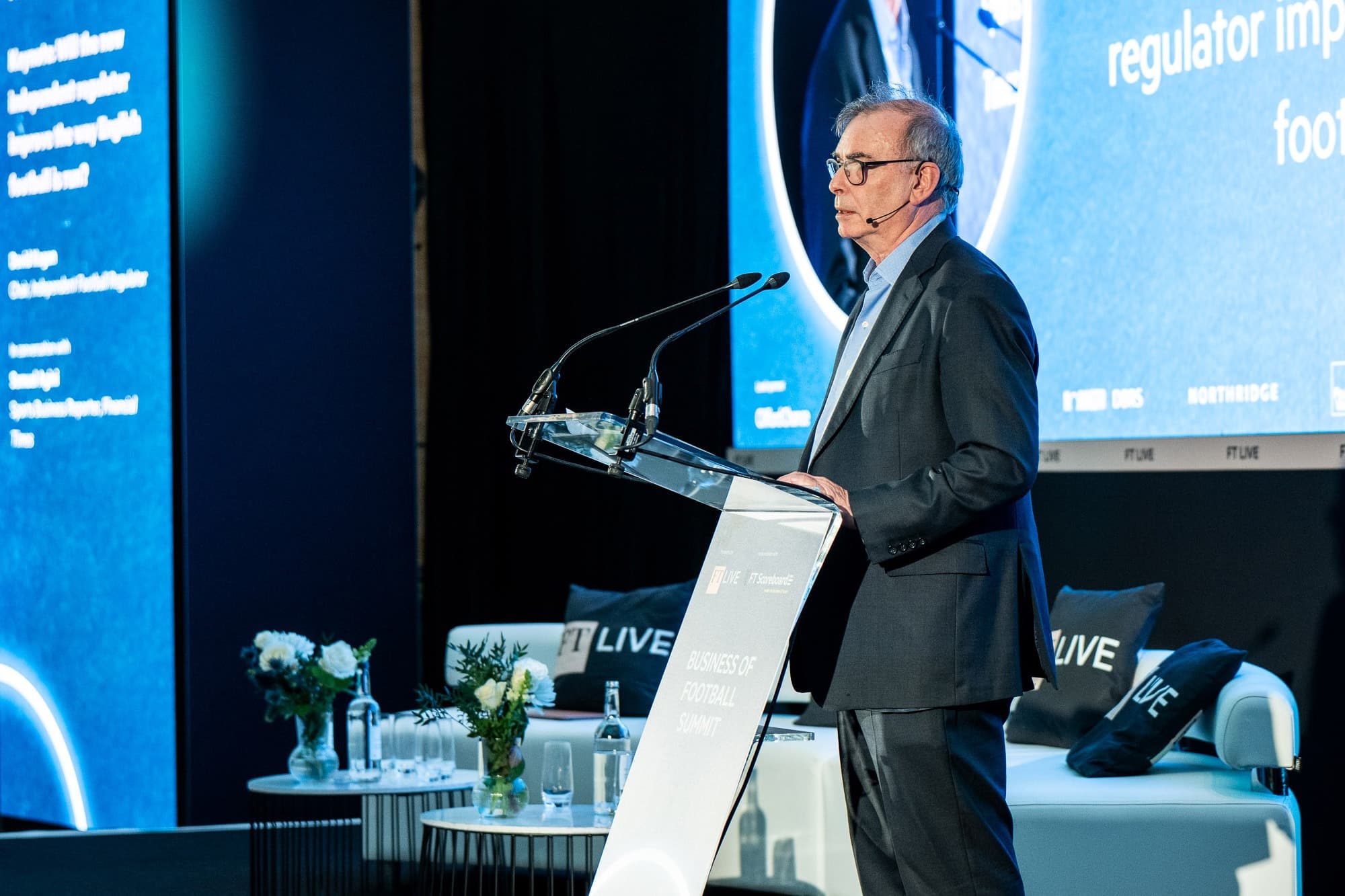
Good morning everyone. It’s a pleasure to be with you here today.
One point to pick up on about what happens in football, it would have been inconceivable five years ago for the Chairman for a new football regulatory body to be addressing this conference.
Thank you to the Financial Times - for not only putting on this excellent conference which brings together the whole of the football industry…but for giving me the opportunity to speak to you about what the new Independent Football Regulator is going to be doing. I realise this is an English club men’s obsession but actually we are the first regulator in the world trying to regulate men’s football. Everything we do is very mindful and setting precedent for the future that others may follow. We got the Royal Assent in July and since then it has been an absolutely full on process to get the IFR up and running and delivering on our mandate.
Our constituency are 116 clubs, we regulate all five top divisions … and each of those clubs have their own interest, their own points of view and their own points of view on the Regulator.
And are of course represented by the Premier League, the EFL and National League – who also have their views and issues.
So we spent most of our time in the first couple of months engaging with the world of football so they could understand exactly what our remit was going to be and what our powers would be and how we would implement them
We have in the course of those last six months met over 100 clubs at a conference in Manchester – the largest ever gathering in the history of English football of its constituent clubs.
We have also been building up our teams in Manchester and in London with a focus on supervision and we are handling the day to day relationship with clubs and competition organisers.
We have also gone live with our suitability test for owners, directors and senior executives.
As of December, we have the power to intervene with the owners, directors and senior executives of existing clubs, and we also have powers over investigations, sanctions and enforcement.
We have run six public consultations on these powers as well as on powers to do with fan engagement with clubs.
In short, we have been implementing the regime which was outlined in the legislation, and the powers will start coming on tap very quickly.
It’s been a lot but 2026 as of March will see us really get up and running.
And if you want an example of why we exist.
One only has to look at the situation in the last 24 hours which has unfolded at Sheffield Wednesday, one of the biggest and most prestigious names in English football, one of the founders of English football, one of the founders of the Premier League that has spent the last two or three years in absolute chaos, including yesterday. It’s obvious why having a regulator that can monitor, examine and if need be act, was relevant to a situation such as Sheffield Wednesday. If we would have existed three years ago, many of the powers we now have would have preempted what has since happened.
The powers we have allow us to monitor the financial soundness of each club, spotting problems and warning signs early so we can help steer them to a more secure future. This is up and down the pyramid of 116 clubs.
In March we will kick off a consultation on the licensing regime that will underpin this with financial regulation attached to it. To be clear for those that don’t realise it, each of the 116 clubs will need to have a license to continue playing football in the English game.
Therefore the licensing regime is of critical importance for the roles we are undertaking.
In May we will get our powers for new owners, directors and senior executives. In other words for those people entering the game and those acquiring clubs, and we have a strong statutory duty in terms of those powers.
By the end of this year we will also publish the draft version of our State of the Game Report, and the State of the Game report was seen by many people as the most important thing we were going to do, because it’s going to be an unprecedented analysis of English professional football that will identify the stresses and strains in the system. We heard from UEFA today that they are doing a similar form of analysis.
Our report will delve into how money flows through the football pyramid; the strength of clubs' balance sheets; and the opportunities, challenges and risks to this nearly £8 billion industry.
It will look at issues such as club debt and liquidity models of ownership, the evolving broadcast landscape, and the impact of player wages and academy development on the financial sustainability of the game. It will be an extremely wide ranging analysis of where football in England sits today, and the risks that are facing it going forward.
It will be the first time any study has investigated the main issues affecting English football in this level of detail, and the reason we are able to do that, is that we have statutory powers to access the information we need from clubs and competition organisers – powers that nobody has had before.
So…why are we bothering to do this?
This appears to be a golden period for English football with revenues up. Attendances up. Worldwide and domestic media audiences up.
As someone who played a part in helping to deliver the commercial success of the English game over the past three decades, believe me when I say that both personally and on behalf of the Independent Football Regulator, we are absolutely committed to do everything to avoid jeopardise the growth we have seen in English football and particularly in the Premier League.
BUT
I don’t need to wait for the findings of the State of the Game report to tell you what everyone already knows – the current system also bakes in risk.
Some of the insights we are already getting from clubs show us this show us this.
One insight. Multiple clubs throughout the pyramid have told us they would not be able to survive a month if their owners pulled funding.
One month.
Two. We know players’ wages have been rocketing in the Premier League but it’s also happening across the whole of the pyramid. In League Two, for example, players costs have doubled in the past 3-4 years… and we know that owners in League One and League Two are worried about this, and how they’re going to finance this arms race.
And three. Relegation for many is a near death sentence. Clubs facing relegation could see their revenues cut by as much as 80 per cent if they fail to bounce back quickly.
Early analysis we have done suggests this is just as much of a problem between League Two and the National League as it is between the Premier League and the Championship. The whole pyramid is facing a number of cliff-edges that people are talking about, but they have not been addressed.
Without better financial mitigations, this is ultimately and entirely unsustainable. That’s the reason the IFR exists.
The time has come to ask the question: Is there another way of distributing income which would make our game more sustainable?
Another way that addresses the cliff edges, that looks at the inflationary spending on players, reducing the pressure on some clubs to gamble their long term future on short term success.
Our mission is to make English football more sustainable, it is our core mission. We are not just doing that for ourselves, but for the clubs.
For the fans.
For prospective owners, because the more solid the pyramid, the better investment opportunity it will be.
And for the entire football pyramid – not just for the very top, and not just for the very bottom.
The issues that will come through the State of Game report have not been addressed in any substantive fashion in the last few years. Underpinning all of them is the issue that no one wants to talk about is the financial distribution within the game.
The history of the last seven years of the Premier League and the EFL, distributing money has gone from Project Big Picture in 2020 and the abortive negotiations in 2023 and 2025 have led to a stasis in finding a new settlement in football.
One direct result of that was the creation of the IFR, I think that if football had found its own solutions, politicians would not have wanted to go through the effort of creating the entity that I now Chair. Within that creation, we have real powers to intervene if football cannot reach agreement – the so called backstop clause.
But I have to tell you as someone that has been involved in football since 1999 that it would be an utter failure by football not to seize the moment and get over the stasis that exists. A deal done in 2019 that simply relies on rolling over every year to no-one’s satisfaction is not sensible practice – it will lead to unsustainable levels of pressure within the system.
It creates uncertainty that is detrimental to the pyramid and to growth and investment in the English game.
Clubs enjoying the good times at the top must surely see that any money passed down through the leagues is an investment, which they themselves will benefit from.
Finding a workable solution will not only deliver on our core mandate to make the game more sustainable but allows less regulation, the more we know by the end of this year when we do the State of the Game report and a relationship and solution has been found, the less we will need to intervene in terms of sustainability going forward. It’s to everyone’s benefit for football to try to reach this understanding.
My message today is that the pyramid needs to survive as it exists today, and to do that English football must come together and end the uncertainty.
And it needs to come together NOW.
At this stage, we don’t have a view on what a solution should look like.
At the stage, it’s for the Premier League, the Football League and the National League to discuss, and try and find a solution to get over the hurdles they created over the last five or six years.
Now, we know this isn’t easy.
If there was a simple solution, then Richard Masters and Rick Parry would have found it. They’re both masters of what they do.
But the difference now is that under our statutory powers as the regulator for the whole of the English game, means any of those leagues can ask us to activate the backstop and, ultimately, we can step in and find a solution.
We do not want to do that. We want football to find a solution and to find it quickly but if the leagues can’t find a new deal, those powers will be enacted.
However, if the leagues can’t find a new deal, then those powers will be enacted. We will be looking at things such as the current mechanism for parachute payments, the cliff edges and other features of the existing deal… because under our mandate we are there to make the game more sustainable.
I hope this message opens up the process again... The clock is ticking … and the opportunity is there.
We are there to help football find those solutions, we are there to regulate this and to protect the football pyramid that English football has depended on for over 160 years. It is a remarkable opportunity as Chair of the Regulator to be able to come to this conference and tell you what is in our minds. It’s the first time we have really talked about it as an organisation. The last six months have been about the building blocks, and the next two years are going to be about enactment.
I hope to come back in a year time and you can mark my homework.
Thank you.